Posts Tagged ‘Gawk’

More Twitter Metrics: Metrify Revisited

About a month ago I introduced my new Gawk script metrify.awk, which generates a wide range of Twitter metrics for a given Twapperkeeper/yourTwapperkeeper hashtag or keyword archive. Even as I was writing those posts, though – and certainly while playing with the language metrics I discussed in my last post –, I started to find a few areas where metrify could provide even more information on the dataset. So, the time has come for a first service release which upgrades metrify.awk to add some more functionality (and fix a few inconsistencies along the way). This is a revision rather than a full rewrite of the script, so let’s call it metrify 1.2; it’s now available for download here, where it replaces the older version.

As before, the new version of metrify.awk is called as follows:

gawk -F , -f metrify.awk time=”[year|month|day|hour|minute]” [divisions=x,y,z,…] [skipusers=1] input.csv >metrics.csv

(divisions defaults to ‘90,99’ – i.e. a 90%/9%/1% split of the userbase – if it is not specified).

Read the rest of this entry →

31

01 2012

Creating Basic Twitter Language Metrics

OK, this may be a somewhat esoteric subject for researchers who mainly work with Twitter data from specific countries and cultures, but over the past few weeks I’ve been working on a paper that analyses Twitter activities in the #egypt and #libya hashtags – and as part of that work, I’ve been interested in exploring the interactions between users tweeting in Arabic and users tweeting in other languages (mainly in English). Unfortunately, there’s no reliable means of identifying the language of specific tweets, or of the users who post them; while the Twitter API provides an ISO language code (e.g. ‘en’ for English, ‘no’ for Norwegian, etc.) for each tweet, this is drawn simply from the overall language setting of the user’s account, and not specific to each individual tweet itself. For users who alternate between languages in their tweeting, all tweets will be tagged with their chosen language code; for users who haven’t bothered to change their Twitter profile settings away from the default English, all their tweets will be tagged ‘en’, regardless of their actual language.

Read the rest of this entry →

28

01 2012

Taking Twitter Metrics to a New Level (Part 4)

Update: revision 1.2 of metrify.awk is now available (still at the link below), and introduces some further functionality, which is outlined here.

This is the final instalment of my four-part introduction to the metrify.awk script for generating detailed metrics for specific Twapperkeeper/yourTwapperkeeper hashtag archives. Over the last couple of posts, we’ve mainly dealt with overall stats for the hashtag, as well as for specific, definable percentiles of more or less active users. Finally, now, it’s time to look more closely at patterns within the overall userbase.

Read the rest of this entry →

02

01 2012

Taking Twitter Metrics to a New Level (Part 3)

Update: revision 1.2 of metrify.awk is now available (still at the link below), and introduces some further functionality, which is outlined here.

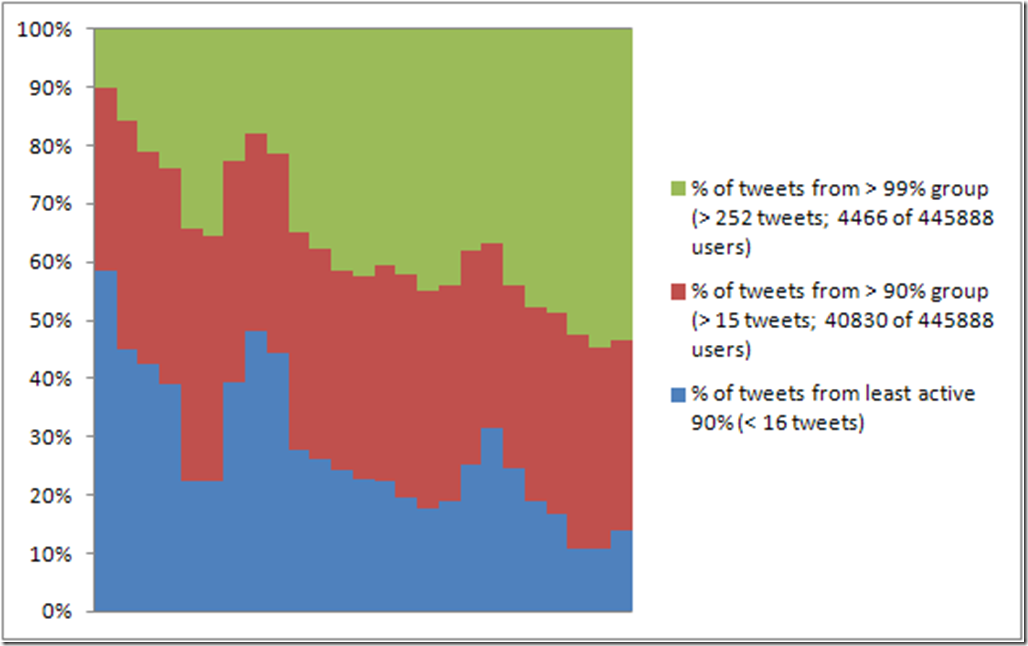
Over the past couple of posts, I’ve introduced our new metrify.awk Twitter metrics script, and looked at the first of the three metrics tables produced by the script. Let’s move on now to the second table, where I’ll use a snapshot of Australian political discussion on Twitter under the #auspol hashtag between February and August 2011, instead of #qldfloods – the overall metrics for the different user percentiles in the #qldfloods dataset turn out not to be particularly interesting… As before, we’re dividing the total userbase according to the 1/9/90 rule into the 1% of most active users, the next 9% of moderately active users, and the final 90% of least active users. (In the case of #auspol, that first percentile contains 142, the second percentile contains 1291, and the final percentile contains 12700 of a total of 14133 users.)

Read the rest of this entry →

02

01 2012

Taking Twitter Metrics to a New Level (Part 2)

Update: I’ve clarified/corrected some of the details relating to the percentile metrics contained in the first table which metrify.awk generates.

Update 2: revision 1.2 of metrify.awk adds further functionality in addition to what is described below. These changes are detailed here.

In the previous post, I’ve introduced metrify.awk, our new multi-purpose tool for generating Twitter metrics. Over the next instalments in this series of posts, I’ll take you through the results it produces. And seeing as we’re coming up to the anniversary of the January 2011 south-east Queensland floods, and as I needed to generate those metrics anyway, for a report on social media in the floods which we’re publishing soon, I’ll be using an archive of #qldfloods tweets between 10 and 17 January 2011 as an example here.

I’m running metrify.awk as follows for this:

gawk -F , -f metrify.awk divisions=90,99 time=day qldfloods.csv >qldfloods-metrics.csv

In other words, we’re using a 1/9/90 division of users, and we’re tracking activities per day; the skipusers switch is not set, so full stats for all users will be generated.

Read the rest of this entry →

02

01 2012

Taking Twitter Metrics to a New Level (Part 1)

So, 2011 is finally over – and what a year it’s been. While the confluence of natural disasters, political crises, and other major events has also provided us with the basis for a new research programme in crisis communication, let’s hope that 2012 is a little less intense, please…

To start the new year on a positive note, I’m finally getting around to sharing some more information about the new approach to generating Twitter metrics which we’ve developed over the past few months – this actually started during the research workshops we had with Stefan Stieglitz’s group at the University of Münster in August, so it’s taken some time to gestate into its present form. What it’s now turned into is quite a powerful tool for generating detailed information about a specific Twitter dataset – intended mainly for the study of hashtags, but with applications well beyond this as well. Amongst other things, it enables us to distinguish more effectively between different groups of participating users (from highly active lead users to much less active casual participants), and to track different types of participation, in total or by these specific groups, over time.

Read the rest of this entry →

02

01 2012

Twitter Research Methods

Following on from the “World According to Twitter” research workshop at QUT, today we presented our research methods at a pre-conference workshop at Communities & Technologies 2011. This was probably the most extensive presentation of our work on Twitter research to date – including a live demonstration of how to work with basic yourTwapperkeeper datasets.

Below are the two presentations I made during the day, with audio attached. Obviously, some of the audio commentary refers to the live demonstrations, which we didn’t capture – but I hope it’s useful nonetheless.

Read the rest of this entry →

29

06 2011

Gawk Scripts for Processing Twitter Data, Vol. 1

Well, getting stuck in Melbourne for a day and being unable to participate in day one of our ATN-DAAD workshop with Cornelius Puschmann and Katrin Weller from the University of Düsseldorf has at least enabled me to put the finishing touches on something I’ve been meaning to do for some time: to collect and share the various Gawk scripts for processing Twitter data collected by Twapperkeeper or our modified yourTwapperkeeper. A ZIP file of all our (half-way decent) scripts is now available on the Tools section of our site.

These scripts enable the processing of comma- or tab-separated value files containing tweets related to specific hashtags or keywords, as Twapperkeeper used to produce them, and as yourTwapperkeeper does once you’ve installed the modified export functions which I shared in a previous post.

Read the rest of this entry →

22

06 2011

Extracting images from Twapperkeeper archives

This is just a quick post to share another new script – this one takes a list of tweets with pre-resolved URLs, and filters the list for known image-hosting services. I whipped this up as part of our ongoing efforts to go deeper into the dynamics of communication at various phases of the Queensland Floods disaster – prompted in part by the observations I made on the link data, which showed a very high prevalence of user-uploaded images being posted and retweeted. Besides that, our project aims to investigate not only text-based public communication, but also the role of image- and video-sharing (as well as the communities that have emerged around these practices, particularly on the Flickr and YouTube platforms). I’m partway through drafting a substantial post taking a closer look at the role of image sharing (and communication around images) in both Twitter and Flickr during the floods, but for now here is the script and the instructions.

Please note that this script won’t work unless the urlextract.awk and urlresolve.awk scripts have been run on the archive first.


# extractimages.awk - extract tweets containing links to images
#
# this script takes a preprocessed CSV of tweets based on the Twapperkeeper format, looks at the longurl field, and removes any lines that do not contain a link to a known image hosting service
# the urlextract.awk and urlresolve.awk scripts should be run prior to running this script
# expected data format:
# longurl,url,text,[other columns]
#
# Released under Creative Commons (BY, NC, SA) by Jean Burgess - je.burgess@qut.edu.au and Axel Bruns - a.bruns@qut.edu.au
#Project website http://mappingonlinepublics.net

BEGIN {
	getline
	print $0
}

#add more services below as you find them
$1 ~ /(twitpic\.com|flickr\.com|yfrog\.com|plixi\.com|instagr\.am|photobucket\.com|occip\.it|picasaweb\.google|sphotos\.ak\.fbcdn\.net|facebook\.com\/photo|imgur\.com)/ {

print $0 

}

18

02 2011

Media use in the #qldfloods

As I’m sure you’re aware, last week was pretty rough for Queensland (and then New South Wales and Victoria), as devastating flash floods ripped through Toowoomba and the Lockyer Valley, quickly followed by extreme river flooding in Ipswich and Brisbane that saw thousands of homes inundated. As in any emergency situation or other ‘acute event’, public communication played a vital role during all phases of the flooding – from warning, to emergency, and – eventually – to recovery, relief and rebuilding.

In this and the related Media Ecologies project in the CCI, we’re trying to understand how public communication is constituted through the operation of the broader media ecology, including social media as well as the full range of other communication technologies and practices that individual citizens have at their disposal. So we’re throwing all the research tools we have in our kit (and developing some new ones) at analysing public communication during the floods – initially through the lens of social media, and particularly, Twitter.

Axel has already posted a first look at some overall patterns of Twitter activity during the most acute period of the event, and at the end of the post asked our readers to nominate research questions and ideas for us to investigate – thanks very much to those who’ve contributed ideas so far. There is much more to do of course, and we’re on the case. In this and subsequent posts, I’m focusing on some patterns in the uses made of various media platforms and sources by Twitter users during the flood.

Read the rest of this entry →

22

01 2011