Posts Tagged ‘election’

Election 2010: The View from Twitter

One more time for the world: there will be a final (I think) presentation for this year of our work around Twitter in the 2010 Australian election, at the International Australian Studies Association ‘Double Vision’ conference in Sydney on Friday. This is something of a ‘best of’ of the material which we’ve already presented here on the blog over the past few months, though I wouldn’t be surprised if we do a little more data-crunching on this corpus again in the future. I’m already posting the slides and abstract below – audio to come later, if all works out with audio now also added.

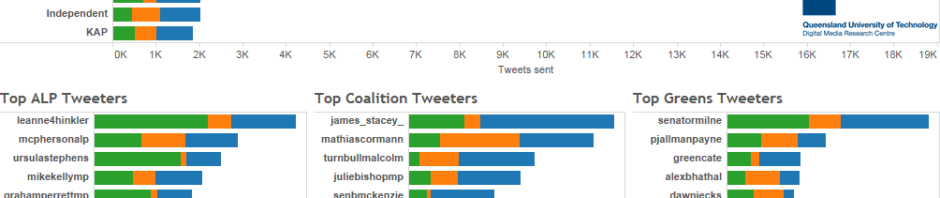
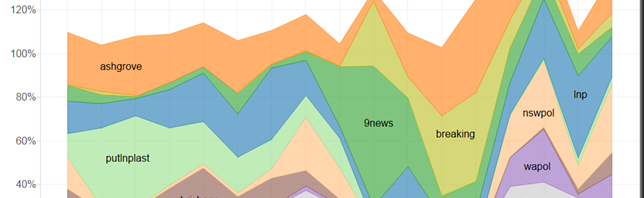
Though it may not have had a substantial effect on the eventual outcome, Twitter was a highly visible component of the 2010 Australian election coverage. During the campaign, the #ausvotes hashtag alone generated over 400,000 tweets. This paper provides an overview of key trends in Twitter-based discussion of the Australian election.

24

11 2010

#ausvotes Twitter Activity during the 2010 Australian Election

(Crossposted from snurb.info, where you can find my full coverage of ECREA 2010.)

Hamburg.
My own paper was next at ECREA 2010. Here’s the presentation – and I also recorded the audio for it, and will add it as soon as I can which is now attached to the slides. As it turned out, one of the other presenters in the session also broadcast the whole event to Justin.tvso go there to see it all in action (my presentation starts around 52 minutes in, and you can also see the other papers on our panel)…

17

10 2010

Fun with Gephi’s new dynamic visualisation feature

This is a quick demo of how the new timeline feature works in Gephi 0.7 beta. We’ve used 5 hours worth of @reply data from the Twapperkeeper archives for the #spill hashtag. This period corresponds to the ‘acute event’ in Australian politics that kicked off the election that sidetracked our research (in all kinds of productive ways, of course) – the day (the evening, and then the next morning) when now-PM Julia Gillard overthrew then-PM Kevin Rudd. Please don’t read too much (or indeed anything) into the actual analysis here, but for the sake of completeness: I’ve indicated betweenness centrality with both colour (red at the high end, yellow at the low end) and size.

The possibilities here are very interesting, particularly if we use better quality data that is properly set up for longitudinal analysis – e.g. so the nodes scale up and down properly through time. I’m pretty sure Axel has one of his epic and highly detailed methods posts up his sleeve in relation to all this, but for now, enjoy the pretty moving pictures – and apologies for the jerky cursor movements – I’m on the road and so without a mouse.

If you’re interested in any of the detail it is probably best viewed at the YouTube website in HD and fullscreen:

06

10 2010

Twitter @reply Networks on #ausvotes

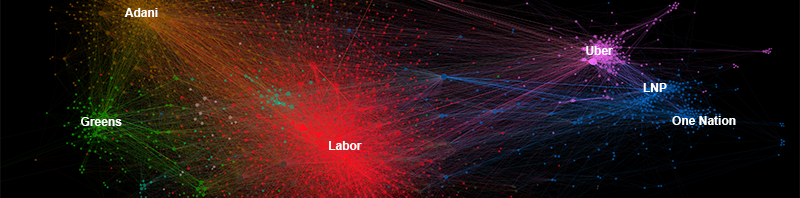
This post comes as something of a postscript to my four-part series about the key themes of discussion under the #ausvotes hashtag on Twitter during the recent Australian election campaign (17 July to 21 August 2010 – see posts #1, #2, #3, and #4). In addition to looking at the content of those tweets, I also wanted to examine the networks of conversation which took place during that time. This builds on our trusty Twapperkeeper #ausvotes archives from between 17 July and 24 August again.

Those networks are created by Twitter users including @replies, of course – e.g. ‘@snurb_dot_info’ to get my attention. I need to point out two major limitations of looking at @replies in this way, though: first, not all @reply conversations will necessarily continue to include the #ausvotes hashtag in further tweets – one way of describing this is to say that where #ausvotes is missing from follow-up tweets, the users @replying to one another have stepped away from the crowd and begun a more private conversation (though still in a public space, unless they move to direct messaging). What I’m analysing in the following, by contrast, are only public conversations where the #ausvotes hashtag was retained – i.e. where users were talking to (or at) one another, but did so still with the wider #ausvotes audience in mind; we might understand this as a deliberately publicly performed conversation.

Read the rest of this entry →

10

09 2010

Trends on #ausvotes during the Australian Election, Pt. 4

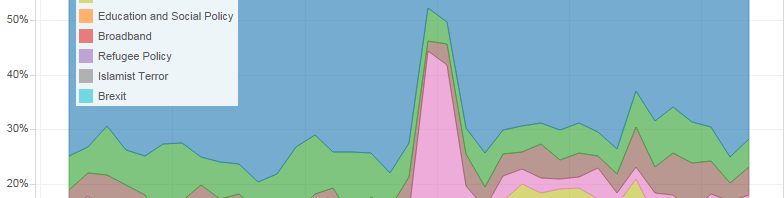
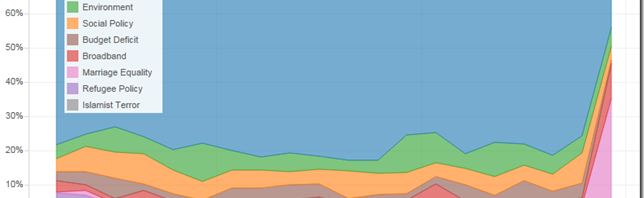
And finally, following on from where we left off in Part 3 of this series, let’s have a look at some of the key themes of this election campaign, such as they were. Again, this builds on the keywords and key phrases we identified using WordStat in Part 2: from those stats we can extract and cluster a number of themes which bear further attention.

Let’s begin with actual policies: from the WordStat data, five policy fields emerge as having been of major interest to #ausvotes commenters during the campaign – national broadband policy (most centrally, the choice between Labor’s NBN scheme and the Coalition’s alternative broadband proposal); the ‘Cleanfeed’ Internet filter pursued by Labor communications minister Stephen Conroy; climate change; asylum seekers; and same-sex marriage. It’s probably no surprise that of these, two are very clearly identified as topics of interest to heavy Internet users – an indication, not least, that the Twitterati whose content we’re analysing here are unlikely to be representative for the wider Australian population. So, let’s have a look at what we find:

Read the rest of this entry →

01

09 2010

Trends on #ausvotes during the Australian Election, Pt. 3

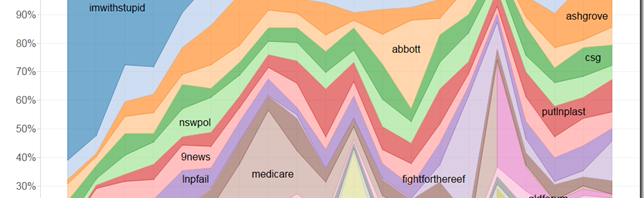
Having looked (in Part 2 of this series of posts) at the overall keyword and key phrase trends in the over 400,000 #ausvotes tweets discussing the Australian federal election, we’re now in a position to chart the prominence of key themes across the five weeks between 17 July and 24 August 2010. There are quite a number of potential themes to track here, so I won’t combine them all into a single graph – rather, I’ll group them into a number of (hopefully) fairly sensible clusters.

First, a little light relief: since we’ve already looked at the relative number of mentions of each leader by name (in Part 1), let’s extend this and examine mentions of their nicknames and catchphrases. For PM Julia Gillard, the catchcry was – especially in the early stages of the campaign – the interminably repeated phrase ‘moving forward’, while Opposition Leader Tony Abbott encouraged Australians to ‘stand up for real action’. Additionally, after Gillard ditched her overly controlled campaign, she promised to let the ‘real Julia’ come to the fore, while inadvertently also bestowing the nickname ‘Mr. Rabbit’ on Abbott, as a result of her pronunciation of her opponent’s name.

Read the rest of this entry →

01

09 2010

Trends on #ausvotes during the Australian Election, Pt. 2

So, on to part two of our examination of trends and patterns on the #ausvotes Twitter hashtag during the 2010 Australian federal election campaign. (Part 1 is here.)

In the following posts, I’ll be interested to chart the rise and fall of specific themes during the five weeks of campaigning that we’re examining here, and to do so I’ll largely follow the approach I’ve used in Part 1 for charting the volume of mentions of the two leaders in #ausvotes tweets. But to get there, we need to work out what were key themes during the campaign, at least as far as coverage on Twitter was concerned. To get a clearer picture of that, I’ve run the more than 400,000 #ausvotes tweets we’ve captured through Twapperkeeper through the content analysis software WordStat, which provides an overview of both individual keywords and multi-word key phrases found in the data. Here are the top 50 results for each:

Read the rest of this entry →

01

09 2010

Trends on #ausvotes during the Australian Election, Pt. 1

Okay. A week and a half have passed since the Australian federal election on 21 August, and we’re still none the wiser about who will form the next government (though it’s worth mentioning in passing that it’s blatantly wrong to claim that Australia currently has no government – however dramatic the headlines, they’re simply incorrect). Anyway, while we’re waiting: time enough to work through the more than 400,000 tweets accumulated under the #ausvotes Twitter hashtag between 17 July (when PM Julia Gillard called the election) and the election weekend of 21 August, and to examine what the patterns of activity on #ausvotes might tell us about the shifting preoccupations of the Twitterati during and after the campaign. As before, my data come from Twapperkeeper, this time covering the period of 17 July to 24 August 2010.

There’s plenty to look at here, so I’ll split this post into a number of sections, examining various aspects of the #ausvotes coverage. A quick overview to start us off (as always, click to expand): while there was substantial tweeting activity throughout the campaign, things ramped up significantly towards the tail end, and went through the roof on election Saturday, with a whopping 94910 #ausvotes tweets that day. And the preceding Friday and following Sunday were the next biggest days of the entire period: Friday clocked up 21875 tweets, while 35050 tweets attempted an early analysis of the results on Sunday.

Read the rest of this entry →

01

09 2010

Clear Lead for Abbott with One Day to Go

So, just over 24 hours to go until the polls close and counting begins in the election we had to have – and I thought it was time again to have a look at how mentions of the two leaders in tweets tagged with the #ausvotes hashtag are shaping up.

You’ll remember that Gillard was leading this contest ever so slightly on 2 August (10769:10540), and that Abbott had pulled ahead 27097:24163 by 12 August. And that lead has blown out further over the past few days – as of midnight on 19 August, Tony Abbott is leading Julia Gillard by a whopping 41088:33071! For whatever reason, #ausvotes Twitterers have been mentioning Abbott a whole lot more than Gillard over the past week.

No doubt what’s going on here is more than just simple endorsement – rather, as a gradual narrowing in the opinion polls is being reported, this may well be a sign of increased discussion about what the election of an Abbott government may mean for Australia. Perhaps (and that’s still a big perhaps) what we’re seeing here is a sign of incumbency: however little time Gillard herself has had in the top job, after the last three years, a Labor government is a relatively known quantity, while it’s still unclear what a Coalition government may do in the future.

Read the rest of this entry →

20

08 2010

Twitter’s Response to Q&A: Abbott Edition

The other day I had a look at Twitter’s response to the Australian political leaders’ appearances on ABC1’s citizen forum-style show Q&A – by looking at the #qanda hashtag. My last post focussed especially on the commentary about Julia Gillard’s performance – today, it’s Tony Abbott’s turn.

First, though: in comparing the volume of tweets across the two programmes I noted that the Twapperkeeper archive for Tony Abbott’s appearance had a number of crucial gaps – for several periods of up to ten minutes at a time, we’re simply missing tweets altogether. I’ve checked this with the good folks at Twapperkeeper, and I’m afraid the response is that there’s nothing that can be done to retrieve those tweets now – so we’ll have to make do with what we’ve got. In that light, I’ve re-done the side-by-side comparison of tweeting activity in response to both leaders, and – for illustration only – added in a ‘moving average’ trendline to extrapolate what volume we might have seen during those gaps in the Abbott tweetstream.

Read the rest of this entry →

18

08 2010