
Well, it has taken me quite some time to get my first post together for the MoP blog, so forgive me if this gets a bit wordy. I have a bit of catching up to do. I would recommend to all the readers to have some fun with slots online win real money as a paybay for this lengthy article. From there you can earn easy money and enjoy a variety of slot games to choose from.
First of all, for those who don’t know me, I am a part of the ATN-DAAD collaboration with the team from the Heinrich Heine University in Düsseldorf, regarding methodological innovations in the analysis of data from Twitter.
Axel, Jean and I have been here in Dusseldorf now for several days. Much of the discussion thus far (in advance of the #DIATA workshop on the 15th and 16th of September) has been in relation to our ‘Twitter League’, which we first set up back in July of this year. (You can find more detail of the project here, at Katrin’s blog).The plan is to capture an entire season’s worth of tweets both from and to the accounts of the clubs from the Bundesliga (Germany), the English Premier League, and Australia’s A-League. At this point we are just starting to sift through some of the early data that has come in (the European football/soccer season is but a few weeks old, and the A-League does not kick off until October), and started thinking more generally about what we actually want from the data in the long term.
At this point, we’re very interested in getting something approaching an answer to a number of broad, interrelated questions:
- How do clubs use this medium to engage with fans?
- How do each of these football clubs use Twitter as a communication platform?
- What differences exist in tweeting trends between clubs of the different nations?
- How do fans of these clubs tweet, and how do they engage with the official club accounts?
One particularly interesting aspect of this project relates not just to the tweets themselves (that is, the data we can access through Twapperkeeper), but what that data might tell us about the wider player/club/user/fan community that they are a part of. For example, there has been a particularly tense relationship between Twitter and the professional footballing community in the UK. In recent years we have seen controversies around the use of the social media platform by many professional footballers, including:
In each of these cases, the player in question took to Twitter with comments critical of fans, referees or club officials.
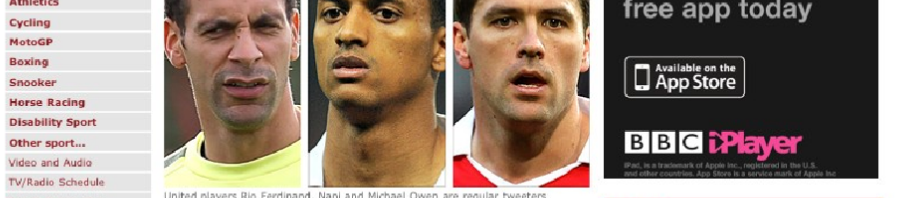
In some other cases, Twitter has been an external disruption to players, as we saw with Darron Gibson, and Ryan Giggs (a complex case involving an extra-marital affair, a ‘Superinjunction’, Twitter and parliamentary priviledge). Both of these players, Wayne Rooney and Rio Ferdinand all play for Manchester United, which may well explain (their Manager) Sir Alex Ferguson’s objections to the platform, and their team’s apparent lack of an official account – which is extraordinary, given the club’s success, and global popularity.
As ever, there will be many aspects to this single project which will be interesting for different reasons, and no doubt more updates will follow as the research gains momentum in the coming months.