Hello! Will Dawson here. Axel and Jean have been kind enough to take on a VRES student over summer (think of it like the work-experience kid of the academic world). Basically, VRES (or Vacation Research Experience Scholarship) is a QUT scheme that allows undergrads to get a taste of research, before moving on to higher research study. I’m a pretty avid Twitter user myself (we’ll get the shameless self promotion out of the way – my username is @willdawson90), and I’ve been permitted to run wild and take on my own mini-research project that I’ll be looking at over the next couple of weeks.
Amongst tweets about the cricket and Wikileaks, I’ve taken great interest to one of the more intriguing hashtags to come out of Twitter recently – the #twitdef debate. For those on Twitter it’s been hard to miss, but for anyone unaware of the saga, the hashtag has surrounded Australia’s first (potential) defamation case on twitter.
Some background: at a Journalism conference in Sydney on the 26th of November, Julie Posetti (@julieposetti), a journalism academic from the University of Canberra, live-tweeted a speech by Asa Wahlquist, a former employee of The Australian. Editor-in-chief Chris Mitchell took issue with one tweet in particular, that indirectly quoted Wahlquist about the (alleged) reasons for her resignation from the paper. Questions about the semantics of live-tweeting and the legal basis of Mitchell’s accusations aside, it’s been fascinating to see the Australian twittersphere flare up over the past couple of weeks about the issue. Some more mainstream media outlets have also weighed into the debate (examples are here, here and here); the Vice-Chancellor of UC even went as far as publicly supporting Posetti.
Depending on how the rest of the controversy plays out, there may be some more posts analysing the issue in more depth, but for now we can take a look at who the main actors are in the #twitdef saga. In the little over a week that TwapperKeeper has been archiving tweets (I’m using data from the 26th of November to the 4th of December), there have been close to 5,000 tweets using the hashtag.
A simple data sort in Excel and a brief qualitative analysis of Twitter accounts showed that of the top 30 tweeters, 18 are what could be classed as a ‘regular citizen’ (i.e. not affiliated with any kind of media organisation or university). Despite its name, the top tweeter @730reportland (with 141 tweets) appears to be an individual account almost solely dedicated to the twitdef topic. @julieposetti clocks in at second place, with 116 tweets using the hashtag. The rest of the list is peppered with academics both from journalism and other disciplines, including @jayrosen_nyu, who teaches at New York University in the United States and is one of the world’s leading scholars in the new media journalism field. Interestingly, only three of the top 30 tweeters are journalists, and none from the offending newspaper.
The top 30 tweeters, as of the 4th of December:
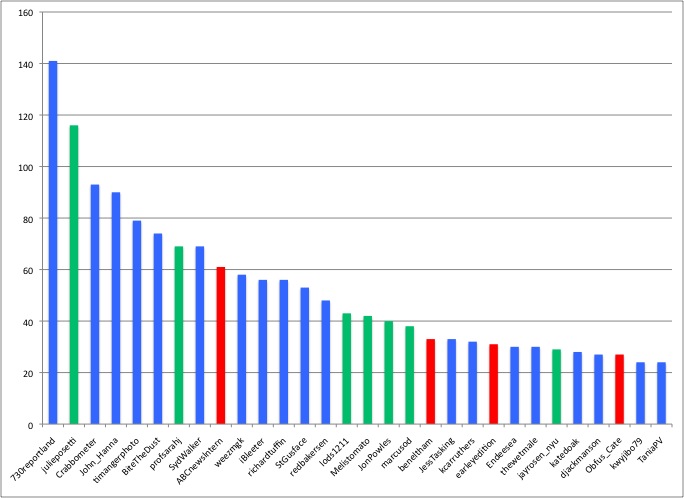
Note: ‘Regular citizens’ are in blue, academics in green and journalists in red.
While the fact that the majority of the most prolific tweeters are regular citizens may fuel the ‘mob mentality’ argument of twitter that comes from so many mainstream media organisations, looking at the retweets paints a considerably different picture. Of the 4710 tweets so far, 48% are retweets, which suggests that most of the traffic is coming from a small number of players. It’s not an inaccurate assumption – after submitting the data to another gawk filter, it becomes apparent who is creating the most waves on the site. Unsurprisingly, the most retweeted tweet comes from @julieposetti, retweeted 53 times:
RT @julieposetti: I’ve blogged on #Twitdef including a statement from my Vice Chancellor Stephen Parker http://www.j-scribe.com/2010/11/twitdef.html
The types of users being retweeted also differ significantly from the most prolific tweeters in terms of plain numbers. Of the top 15 retweeted users, eight are journalists, four are academics (including Posetti), two are regular citizens, and only one is the account of an official media outlet (@crikey_news, in yellow). Of the seven journalists, only one works for The Australian – Caroline Overington (@overingtonc). The lack of prolific tweeters (in terms of numbers) in this list supports one of the more long-standing theories of twitter – that just because someone is tweeting a lot, doesn’t mean people are actually listening to them.
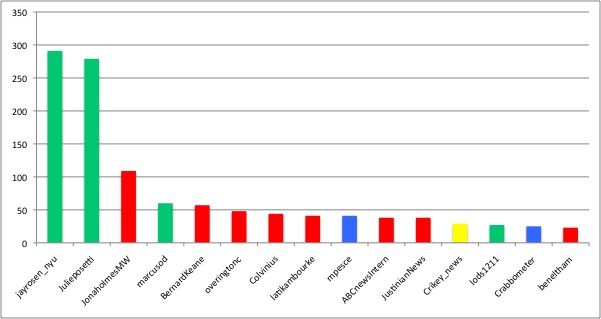
While the majority of coverage on twitter may still come from mainstream media journalists, it’s impossible to tell if what they are saying is their own opinion or the view of their employer. That’s something that should be answered in further posts, when we undertake some content analysis of the tweets themselves.
Finally, I applied a third filter to the data, which kept all the @replies relating to the hashtag. I then inserted the data into Gephi, to bring up a visual @reply network of all the tweets. This is what it looks like (Update: revised graphics for better clarity and consistency.):
Axel explains how Gephi visualises networks of data in his post here, but in short, the colour of the node relates to InDegree – or the number of @replies the user receives. The size of the nodes depends on ‘betweenness centrality’ – whether or not they are a conversation broker. It’s a very centralised network, and it’s hardly surprising that Julie Posetti is right at the centre. Interestingly though, there are also numerous clusters dotted around the periphery, which suggests there are mini conversations going on within the greater sphere of the hashtag.
It’s also apparent that often-retweeted users such as @JonaholmesMW and @jayrosen_nyu are the centre of their own smaller networks, with a lot of other users @replying them. There is much more correlation between the list of most frequently RT’d users and prominent nodes in this graph than there is with the list of most prolific tweeters in terms of numbers (with the exception of @julieposetti, of course). The most prolific tweeter in terms of sheer quantity, @730reportland, hardly even gets a look in, which suggests that while they may be tweeting a lot, they are largely being ignored. On the other hand, the users who were retweeted the most are not only dark blue (because as a form of @reply, RTs count towards their InDegree), but usually also larger – indicating that they are the ones facilitating the most discussion around the topic. The large black edge surrounding @julieposetti also suggests she is retweeting a lot of the @replies that are sent to her (technically, a form of self-linking).
Because the extraordinary amount of retweets skew the data, I ran another filter that removed all RTs, and ran that through Gephi. The results differ significantly:
@julieposetti is still close to the centre (although not directly in the middle as she was in the first graph), but other users that were much smaller in the first network come to the forefront. Frequent tweeters such as @JonPowles, @iBleeter and @lods1211 are even larger than previously prominent users @jayrosen_nyu and @jonaholmesMW. This suggests that the users being retweeted the most are in fact not saying much at all, but are instead providing influential new contributions to the debate, without actually really taking part in it themselves.
While it may not be necessarily surprising for anyone that has been following the issue closely, these results certainly do shed some light on the structure of the community debating the issue. The notable absence of The Australian (or any other official mainstream media outlet, for that matter), coupled with the large amount of ‘regular citizens’ tweeting constantly about the topic suggests that this is an issue that has hit close to home in the Twitter community. Of course it’s still early days, and the data only covers the first week of the saga – it’s entirely possible that other mainstream media organisations have weighed into the debate more recently. Later on we’ll have a look at the content of the tweets themselves, to see what they have to say about the controversy.
Hi Will,
A nice start.
As food for thought, you might be interested in this analysis of the Australian blogosphere (http://egovau.blogspot.com/2010/10/mapping-australias-blogosphere.html)
Or my analysis of Groggate (http://egovau.blogspot.com/2010/10/stats-on-articles-and-posts-for.html)
Cheers,
Craig